Ten Minutes — and the Fish Is Cured?
Imagine a familiar situation in an aquarium. A fish rubs against rocks, there is more mucus on its skin, and it behaves restlessly. What is happening? Perhaps parasites are irritating it. Or perhaps the cause is something entirely different.
But the decision has already been made: “Let’s give it an FMC bath.”
The fish is placed in water containing the treatment for ten minutes and then returned to its aquarium. The procedure is complete. It may seem that all we have to do now is wait for the fish to recover.
But what actually happened during those ten minutes? Did the treatment have enough time to affect the parasites? And were parasites even the cause of the problem?
What Is FMC?
FMC is the name of a mixture used to treat certain diseases in fish. The formulation discussed here contains:
- Formalin — an aqueous solution of formaldehyde that acts against some external pathogens but can also harm the fish itself.
- Malachite green — a chemical dye with antiparasitic activity.
- Methylene blue — another dye with biological activity.
Each component has its own properties and limitations. Combining them does not create a universal cure for every disease.
And there is an important distinction: “This product works against some parasites” and “Any bath with this product will help” are not the same claim.
Why Ten Minutes Is Not a Magic Number
Treatment depends not only on what we add to the water. Just as important are the concentration of the treatment in the water and how long the fish is exposed to it.
Consider two different approaches. In one, a small amount of the product is added to a large volume of water and left to act for a long time. In the other, a more concentrated solution is used for a short period. These are different exposures, even if the product name on the label is the same.
When the FMC mixture was originally proposed, the approach involved prolonged exposure to a low concentration — for roughly two days. Formalin on its own has also been used in other regimens, including short baths. But that does not mean the exposure time used for formalin alone can automatically be applied to FMC. The details and references are available in the F.O. analysis.
So where did those ten minutes come from? If the only answer is “That’s how we’ve always done it,” then we have a habit, not an explanation.
What If the Fish Looks Better After the Bath?
Suppose that by the next day the fish has almost stopped rubbing against rocks. There is less mucus on its skin. Does that mean the FMC worked?
Possibly. But not necessarily.
Some parasites may have died or detached. Some of the mucus may have washed away. The fish may have been moved into more suitable water. The irritation may have decreased for an entirely different reason. An improvement in appearance alone cannot tell us exactly what happened.
The opposite situation is also possible: the fish looks better, but the pathogen remains. The problem then returns, even though the bath initially seemed successful.
To tell these possibilities apart, we should at least try to establish what was present before treatment and what changed afterward. For example, we might examine material from the skin or gills under a microscope, when feasible and justified.
An improvement in appearance is an observation. Elimination of the cause of disease is a conclusion that requires additional evidence.
What If Parasites Were Not the Reason the Fish Was Rubbing?
Fish can rub against objects for different reasons. That behavior alone tells us neither the name of the disease nor which medicine to use.
If we have not identified the cause, then after the bath we cannot confidently say what we were actually treating.
A particularly troubling possibility is that the parasite is resistant to the chosen treatment or protected within the tissues, while the product further irritates the skin and gills of an already weakened fish.
In other words, we tried to fight the disease but placed an additional burden on the animal without solving the original problem.
So What Counts as Treatment?
A medicated bath is an action. Treatment is an attempt to achieve a particular biological outcome.
First, we need to understand what is happening to the fish. Then we need to decide which cause we intend to address. Only then can we choose an appropriate method and check whether the thing we were trying to change has actually changed.
Sometimes FMC will be a justified choice. Sometimes a completely different intervention will be needed. And sometimes the first step should not be adding a chemical at all, but checking the conditions in the aquarium and investigating the problem.
We gave the fish a bath — that’s a fact. Whether we cured it remains to be demonstrated.
That is why turning treatment into a familiar ritual is dangerous. Not because FMC is “bad” or “outdated,” but because no medicine can replace the question: “What exactly am I treating this fish for?”
Want to explore the subject in more depth? F.O. — why concentration and exposure time matter more than a familiar product name · F.O.S. — a full analysis of FMC, its history, and the literature.
See also
I. The Method.
 Tradition Instead of Science I. The Method.What can staining still reveal when the classic Ziehl–Neelsen method cannot be performed in full? Exploring the roles of phenol, heat, and …
What Is Your Evidence?
Tradition Instead of Science I. The Method.What can staining still reveal when the classic Ziehl–Neelsen method cannot be performed in full? Exploring the roles of phenol, heat, and …
What Is Your Evidence?
 What Is Your Evidence?Why photographs, videos, and polished explanations are no longer enough in the age of generative AI. A practical look at provenance, …
Flying Elephants
What Is Your Evidence?Why photographs, videos, and polished explanations are no longer enough in the age of generative AI. A practical look at provenance, …
Flying Elephants
 Flying ElephantsWhy science requires more than an elegant hypothesis. The role of photographs, videos, specimens, and primary data in building and verifying …
Cryptococcus-like structures in fish
Flying ElephantsWhy science requires more than an elegant hypothesis. The role of photographs, videos, specimens, and primary data in building and verifying …
Cryptococcus-like structures in fish
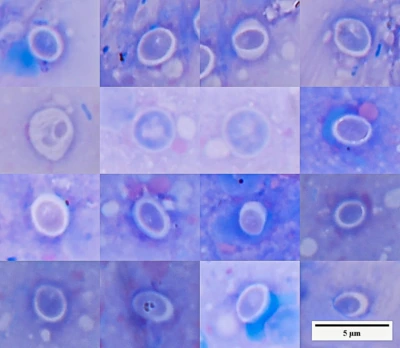
 Cryptococcus-like structures in fishRound structures with a distinct halo, morphologically resembling cryptococci. Morphological analysis and limitations of interpretation.
Granulomas and intracellular agents
Cryptococcus-like structures in fishRound structures with a distinct halo, morphologically resembling cryptococci. Morphological analysis and limitations of interpretation.
Granulomas and intracellular agentsin fish
 Granulomas and intracellular agents in fishA collection of real observations: intracellular yeast-like organisms, coccidia, cryptosporidia, and fungal structures in fish.
Cryptocaryonosis: killing the parasite
Granulomas and intracellular agents in fishA collection of real observations: intracellular yeast-like organisms, coccidia, cryptosporidia, and fungal structures in fish.
Cryptocaryonosis: killing the parasiteor treating the water?
 Cryptocaryonosis: killing the parasite or treating the water?A practical analysis of cryptocaryonosis treatment in marine fish: why killing the parasite should not become more important than the …