There’s a common belief that if a fish dies in an aquarium, an autopsy is pointless. It’s often claimed that you must dissect immediately after death, otherwise nothing useful can be learned. The reasoning goes like this: fish decompose very quickly at room temperature — within minutes, tissues change, organs lose structure, and parasites either die or abandon the host.
Aquariums are “full of bacteria,” so decomposition starts instantly.
Organs can’t be assessed accurately — color, consistency, and integrity are distorted.
Surfaces get covered by bacteria, making it impossible to distinguish pathogens from postmortem contamination.
Parasites leave the dying host, and the remaining ones die quickly.
Organisms found later may just be saprophytes and misinterpreted as disease agents.
The conclusion often drawn: if a fish has been dead for even a short time, there’s no point in examining it — you can’t identify pathologies or parasites.
Reality
“Fish that died in the aquarium should not be dissected!”
Fish necropsy
That statement is misleading. Even in human forensic medicine, bodies are examined long after death. Why should fish be an exception?
Research in pathology and forensic science shows that diagnostic features often remain visible for hours, sometimes days, if interpreted correctly.
“Tissues change within minutes”
Yes, changes begin after death, but that doesn’t make organs useless.
Veterinary and medical pathology accounts for stages of autolysis and evaluates decomposition in context. Fish metabolism is fast, but at normal room temperatures, significant structural loss takes longer than “a few minutes.”
This is where experience and logic matter most — interpretation is key.
“Parasites die or leave the host” — is that true?
Where would they go?
Most fish parasites have life stages that do not include active relocation between hosts. Parasites are adapted for minimal activity — that’s why so many lack eyes, limbs, or even advanced organs. Even parasitic crustaceans, once attached, transform into sedentary forms focused solely on reproduction.
If an adult parasite detached, it would likely die. Even ciliates like Cryptocaryon or Ichthyophthirius can’t actively swim once they enlarge for division — their cilia are too small relative to body size.
Some species, like Monogenea, have a free-swimming larval stage (oncomiracidium), but only during initial colonization, not after maturation. Mature forms equipped with hooks for attachment cannot “crawl around the tank” looking for new hosts (Buchmann & Lindenstrøm, 2002; Olstad et al., 2006).
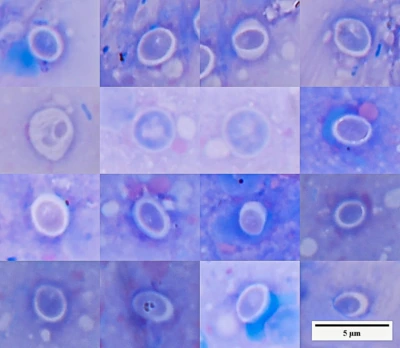
In reality, most parasites remain on the host until they themselves die — usually because bacteria begin breaking down the tissue. Protozoans can still be identified morphologically for hours postmortem, especially in smears, imprints, or stained samples (Tarannum et al., 2023).
Later, when decomposition advances, they disintegrate completely.
Bacteria don’t flood the body instantly
They don’t “burst out” of the gut the moment the fish dies. Tissue structure acts as a barrier (Brooks, 2016; Mesli et al., 2017). If there were no bacterial colonies on internal organs during life, they won’t magically appear immediately after death.
And postmortem cannot create lesions typical of infection — ulcers, hyperemia, granulomas simply don’t develop after death.
Decomposition takes time. Even at 22–27 °C, bacterial growth and tissue breakdown progress slower than intuition suggests. Lower temperatures slow it even more.
“There are lots of bacteria in the aquarium, so decomposition is instant”
“Lots” is relative.
Think about this: why is fresh tap water cloudy right after filling an aquarium — and why does it clear after standing for a day or two?
Fact: That’s physics, not bacteria.
Cloudiness comes from microbubbles released when water pressure drops (pipes run at higher pressure than the room).
Within 12–48 hours, gases escape, and water clears — not because “bacteria died,” but because bubbles disappeared.
For a true bacterial bloom, you need:
Organic matter (food)
Time (hours to days for exponential growth)
Conditions (nutrients)
Clean tap water is extremely poor in organics. A “sudden bloom” from nothing is impossible.
“Some organisms found on a dead fish are mistaken for the cause of death”
True — but that’s not a reason to skip necropsy.
In forensic work, insects on a body aren’t mistaken for the cause of death — trained professionals interpret evidence properly. The solution isn’t “don’t look,” it’s “learn to interpret.”
Don’t confuse risk of misinterpretation with uselessness of examination.
Reference
Brooks, J.W., 2016. Postmortem Changes in Animal Carcasses and Estimation of the Postmortem Interval. Vet Pathol 53, 929–940.
https://doi.org/10.1177/0300985816629720
Buchmann, K., Lindenstrøm, T., 2002. Interaction between monogenean parasites and their fish host. International journal for parasitology 32, 309–19.
https://doi.org/10.1016/S0020-7519(01)00332-0
Olstad, K., Cable, J., Robertsen, G., Bakke, T.A., 2006. Unpredicted transmission strategy of Gyrodactylus salaris (Monogenea: Gyrodactylidae): survival and infectivity of parasites on dead hosts. Parasitology 133, 33–41.
https://doi.org/10.1017/S0031182006009966
Tarannum, A., Rodríguez-Almonacid, C.C., Salazar-Bravo, J., Karamysheva, Z.N., 2023. Molecular Mechanisms of Persistence in Protozoan Parasites. Microorganisms 11, 2248.
https://doi.org/10.3390/microorganisms11092248
FAQ
Can a fish be examined hours after death?
Yes. Diagnostic features can remain visible for hours. The key is to interpret postmortem changes correctly, not to avoid examination.
What happens to tissues after death?
Autolysis begins, but it is a gradual process. Structural and morphological features often remain identifiable for a considerable time.
Do parasites leave the host after death?
No. Most parasites remain in place and gradually degrade along with host tissues. They do not actively leave the body.
Can bacteria mislead the diagnosis?
Yes, if interpreted incorrectly. Postmortem bacterial growth can occur, but it does not create disease-specific lesions from scratch.
When does an autopsy become useless?
When tissue structure is completely destroyed and no meaningful morphology remains. This takes time and depends on environmental conditions.