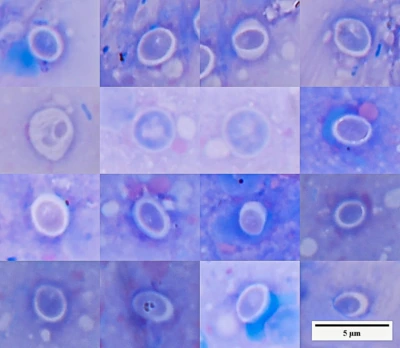
Round structures with a distinct clear halo are periodically observed in fish preparations.
Visually, they resemble encapsulated yeast-like forms and may be associated with cryptococci. However, morphological similarity alone is insufficient for diagnosis.
This page presents observations of such structures and an attempt at careful interpretation in context.
Comparison with literature data
In the classical presentation, cryptococci appear as round cells with a prominent capsule, often showing budding and localizing within tissues, including inside macrophages.
Observation
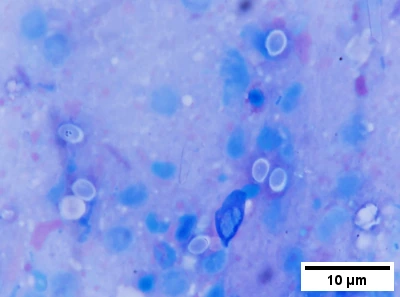
In native preparations, round elements with a clearly defined peripheral halo are observed. Sizes vary, and the internal content is heterogeneous, with visible inclusions in some structures.
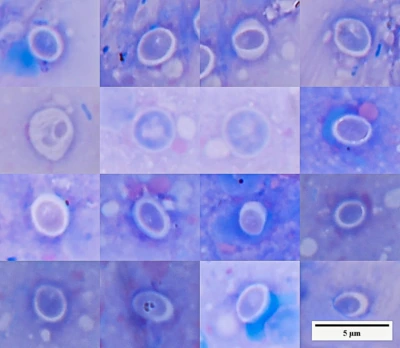
Some objects appear similar, but closer examination reveals marked variability. Consistent budding, typical for yeast forms, is not observed in most cases.
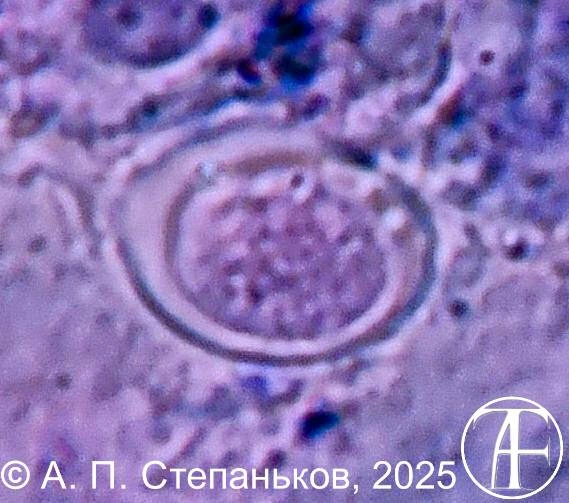
In some preparations, structures with a well-defined wall and pronounced internal content are observed.
Unlike typical yeast forms, the central area here is heterogeneous and composed of multiple inclusions. This pattern may correspond to a developmental stage or sporulation and requires cautious interpretation. The presence of such internal organization further suggests that these objects should not be automatically classified as cryptococci based solely on the presence of a halo.
Clinical context
Similar structures were identified in Danio rerio.
The process was systemic, involving parenchymal organs. Granulomatous inflammation was observed. Mycobacteriosis was excluded based on microscopy. In this context, the morphological findings are unlikely to be incidental. They integrate into the overall pattern of the disease, making a fungal origin plausible.
Interpretation
The combination of intratissue localization, granulomas, and round halo-containing structures does resemble cryptococcus-like lesions. However, key features required for a confident diagnosis of cryptococcosis are lacking. Most notably, there is no consistent budding, and the observed structures are morphologically heterogeneous. In addition, a halo is not a specific feature and may arise under various conditions, including osmotic effects and preparation artifacts.
Conclusion
Round structures with a pronounced halo may resemble cryptococci, especially in the presence of granulomatous inflammation and internal organ involvement. Nevertheless, morphology in this case provides only a direction for interpretation and does not allow a definitive diagnosis.
Such findings require cautious evaluation within the full context of the process.